
Group Leaders: Tolullah Oni, Louise Foley
Introduction
The Global Public Health group studies how the places, systems and policies that shape everyday life can be changed to improve population health and reduce inequalities. Our work focuses on the structural drivers of health-related behaviours and health outcomes, including urban environments, food systems, transport systems, climate-related exposures and wider social, economic and political conditions.
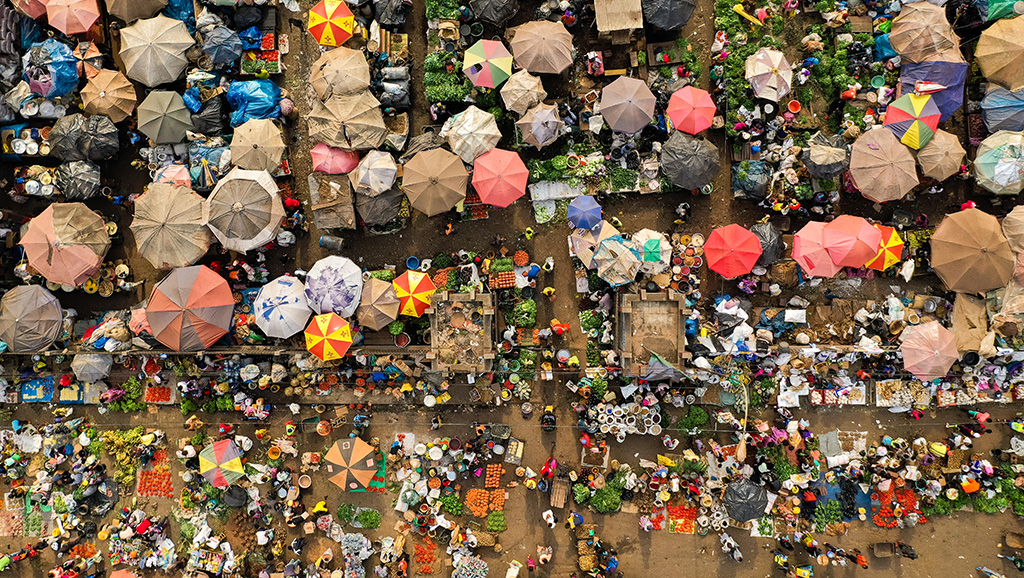
We work across low-, middle- and high-income countries. Our current and previous work spans Africa, South America, the Caribbean, South and South-east Asia and other international settings. Across these contexts, we are interested in how rapid urbanisation, changing food environments, climate change and economic development are reshaping risks and opportunities for health.
Our research is applied and practice-facing. We work with governments, city and national agencies, community organisations, civil society partners and citizens to generate evidence that can inform real-world decisions. We use epidemiological, public health, social science, citizen science, systems and natural experimental methods to understand how environments and policies influence diet, physical activity and related health outcomes, and to identify interventions that are feasible, equitable and effective.
A central theme of our work is the role of cities as settings for health creation. Cities concentrate many of the forces that shape health, including housing, transport, public space, food retail, air quality, heat exposure and access to services. We study how urban infrastructure and governance can be designed, adapted and evaluated to support healthier behaviours, reduce exposure to environmental risks and build resilience in a rapidly changing climate.
Professor Tolullah Oni works at the nexus of health, climate resilience and rapidly growing cities. Through the African Diaspora Centre for Healthy Urban Futures and UrbanBetter, her work focuses on the urban systems that shape health outcomes (including air pollution, heat, public space). She combines citizen science, spatial epidemiology and policy research with youth and community engagement to activate urban infrastructure for health. Professor Louise Foley’s work focuses on the evaluation of population health interventions, natural experimental approaches, food and physical activity environments and developing methods for evidence synthesis. Together, the group aims to produce the evidence and partnerships that help governments and communities act on the upstream determinants of health.
Current research themes
- Healthy, sustainable cities: understanding how urban form, transport, public space, housing, air quality and heat shape behaviour and health, and how cities can be designed and governed to generate health.
- Food systems and nutrition transitions: studying changing food environments and food practices in different settings.
- Physical activity, active mobility and public space: examining how built environments, transport systems, public space and climate-related risks affect opportunities for active living.
- Climate, health and resilience: exploring how climate change, heat, air pollution and environmental vulnerability intersect with urban development, health behaviours and health inequalities.
- Structural and policy interventions: developing and evaluating interventions that act beyond individual behaviour change, including changes to fiscal, physical, social and policy environments.
- Data, methods and tools for public health action: linking environmental, behavioural and health data, using natural experimental and systems-informed methods, and developing tools that can support policy and practice.
- Partnership, participation and citizen science: working with governments, communities, young people and civil society to make local evidence visible and actionable.
Examples of current work
- African Diaspora Centre for Healthy Urban Futures (UrbanBetter Academy @ Cambridge): A partnership with UrbanBetter, the Centre – co-led by Oni and Okello – brings together coalitions of researchers, community and policy actors and Global Africa expertise to conduct action-oriented health/climate research that supports scientifically robust, decision-ready evidence that can shape climate and health policy and action. The Centre is also focused on training the next generation of civic, city and science leaders to shape healthy sustainable urban transformation.
- Hotsteppers: Active Lives in Hot Spots: a climate-health initiative in Lagos, Nigeria, generating evidence and supporting action on extreme heat exposure, active mobility and healthier, more climate-resilient urban environments.
- Health-driven design for cities (HD4): Based in Singapore, a tropical Asian mega-city, HD4 investigates how people live and move through the city, how urban environments shape exposure to health risks and how evidence can guide planning and health strategies.
- South Asia Biobank: linking information on environments with detailed behavioural and health information collected in a major South Asian cohort to understand how places and exposures shape population health.
- Food environments and the nutrition transition in Kenya: exploring how changing food environments and food practices are influencing diet, nutrition and health in Kenyan cities.
Previous grants and studies
- Global Diet and Activity Research Network (GDAR): established in 2017, the Global Diet and Activity Research Network (GDAR) is an international research partnership working to support sustainable development and prevent non-communicable diseases (NCDs). Read our reflections on eight years of research here.
- The Informal Appropriation of Public Space for Leisure Physical Activity (ALPhA) study: explored the ways that public space was being informally used for physical activity in Lagos, Nigeria and Yaoundé, Cameroon.
- Exploring foodscapes in Small Island Developing States through a transition lens: identifying the role of highly diverse and interconnected food sources in SIDS, with particular emphasis on the importance of food sharing practices.
- Urban informality and food environments: Obesogenicity, business operations, and governance in Cape Town’s informal food retail sector
- Community food and health: this project is co-designed and evaluated society-led interventions to improve community-based food production in the Caribbean and the Pacific.
Group members
- Louise Foley – Group Lead, Research Professor
- José Izcue Gana – PhD student
- Trupti Kulkarni – Programmes/Centre Manager, UrbanBetter Academy @ Cambridge
- Gabriel Okello – Assistant Research Professor & Co-lead, UrbanBetter Academy @ Cambridge
- Kufre Okop – Assistant Research Professor
- Tolullah Oni – Group Lead, Clinical Professor
- Barbara Rubiell – Assistant Research Professor
Former group members
- Nina Abrahams – Research Associate
- Mayami Abdulla – GDAR Coordinator
- Kenneth Anujuo – GDAR Coordinator
- Anna Brugulat Panes – PhD Student
- Tiago Canelas Ferreira – Research Associate
- Pamela Carbajal Perez – GDAR Coordinator
- Florence Nabwire – Prince of Wales Fellow in Public Health Nutrition in Sub-Saharan Africa, Cambridge Institute for Sustainability Leadership
- Malaika Hirani – Project Coordinator
- Clare Hodkinson – GDAR Coordinator
- Erin Mathieu – Visiting Researcher
- Camille Mba – PhD Student
- Alice McGushin – Academic Clinical Fellow
- Trish Muzenda – PhD Student
- Natasha O’Sullivan – Academic Clinical Fellow
- Mohammad Sayeem – PhD Student
- Annie Schiff – Project Administrator
- Lambed Tatah – Research Associate
- Meelan Thondoo – Senior Research Associate
- Nigel Unwin – Clinical Professor
- Fiona Whittle – Project Coordinator